

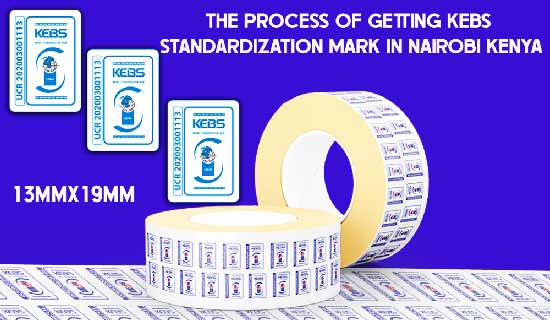
The process of getting KEBS STANDARDIZATION mark in Nairobi Kenya
The process of getting KEBS STANDARDIZATION mark in Nairobi Kenya is very importantTo any entrepreneur or any business person getting to either business export, manufacturing or just selling products in Kenya. However, Kebs does not stop there, there some who import products in Kenya and they need to know where Kebs Stickers printing In Nairobi Kenya is done, before you get to Nairobi Kenya Kebs sticker printing, you need to understand the process of applying kebs standardization mark, the time frame to wait for you to get your kebs standardization. And that is what we are going to discuss on this article, without saying much lets jump to the article and find out the The process of getting KEBS STANDARDIZATION mark in Nairobi Kenya is very ,Kebs stickers printing and other detail about Kebs stickers label .
KEBS standardization mark permit in Kenya
This post will explain the process for applying for a KEBS standardization mark permit in Kenya as well as the conditions that need to be satisfied in order for the application to be approved.
For goods produced domestically for export into the East African Community (EAC) and for domestic consumption, a KEBS Standardization Mark is required. After conducting a factory inspection, the Kenya Bureau of Standards (KEBS) gives a standardization mark license and a soft copy of the standardization mark to use when branding the products. The license is good from the date of issuance for one calendar year.
How to apply for a permit to use the KEBS Standardization Mark
Stage One
- Complete the Standardization Mark Application Form (STA 1).
- Fill out the initial factory assessment form (STA 10) (New applicants only).
Before an inspection can take place, the applicant must complete the STA 10 form and submit it to KEBS.
- Fill out the standards levy notification form (SL1) in duplicate.
- Submit a duplicate of the company registration form, i.e., CR12 for Ltd companies, as well as evidence of registration for CBOS, cooperative societies, self-help groups, and others.
- Clear the product certification fees.
Please keep in mind that there is no need for product samples when submitting your application. You can also obtain STA1, STA 10, and SL1 forms from your nearby KEBS office.
Stage Two
The quality assurance officers from the Kenya Bureau of Standards will visit your factory in order to conduct an industrial inspection, collect samples for analysis, and decide on a plan for monitoring and control.
Stage Three
To ensure that your product samples comply with Kenyan standards, they will be examined at KEBS laboratories or any other accredited testing facilities. A recommendation for the granting of the permit to use the standardization mark will be done to the Permit Standardization committee (PSC) if tests conform and the inspection officer’s report shows compliance with codes of practice.
A permit will be granted if the board certifies that all conditions have been satisfied. Should your product tests not meet the requirements, retesting will be performed at no cost, and if the product meets the requirements, a license to use the standardization mark will be provided. Samples will be tested at the the company’s expense if they don’t pass the second round of testing and any further tests.
KEBS Certification Fees
A. All Large Companies
20,000 for the company plus Kshs. 7,500 for each brand or product. This refers to businesses with an annual revenue of between Kshs. 200, 000 and Kshs. 500,000.
B. Medium Size Companies
10,000 for three items plus Kshs. 5,000 for any additional product
This refers to businesses with annual revenue under Kshs. 200,000.
C. Small Companies & Jua Kali
5,000 for three items plus Kshs. 5,000 for any additional goods.
NOTE:
The full application fee for a standardization mark is paid at the time of submission. The client must pay Ksh. 1000 for any change requests made on the permit, which will be evaluated and approved.
KEBS CONTACTS
P.O. Box 54974 – 00200
Nairobi, Kenya.
KEBS STICKERS PRINTING
Once you are done with KEBS and you have been given your KEBS number the next step is to look for a printing company to print your KEBS stickers for you to place on your products.That is where we come in. Our team will help you print your KEBS stickers on quality material that does not rip-off easily. Contact us today for quality KEBS sticker Printing.

Where Label Gurus comes In KEBS STANDARDIZATION
To conclude, while the process of getting KEBS STANDARDIZATION mark in Nairobi Kenya is crucial for anyone entering the Kenyan market, obtaining the mark is only part of the journey. Once your application is approved, you’ll need reliable Kebs Stickers printing in Nairobi Kenya to stay compliant. That’s where Label Gurus comes in—as your go-to provider for professional Nairobi Kenya Kebs sticker printing. With your kebs standardization mark ready, we ensure your products are labeled to meet regulatory stand, we Label gurus design we are just one phone call away incase you need Kebs stickers label printing services .
Other Ranges Services We offer As Label Gurus designs
We Label Gurus design we also offer other ranges of services that we feel they will be beneficial to our customers and they include
Milk Pouch Packaging Designs, Tissue Packaging Designs, Maize Flour Packages designs , Cereals packaging designs services , Bread Packaging Designs , Pillow Cover Designs ,Serviettes Packaging Designs Customized water label designs , Logo designs services and company profile design services Business profiles
Frequently Asked Questions (FAQs)
1. What is the KEBS Standardization Mark in Kenya?
The KEBS Standardization Mark is a product certification mark issued by the Kenya Bureau of Standards for goods made in Kenya for local sale or export within the East African Community.
2. Why is the KEBS Standardization Mark important?
It is important because it shows that a product has gone through inspection and testing to confirm compliance with the required Kenyan standards.
3. Who needs a KEBS Standardization Mark permit in Kenya?
Manufacturers producing goods for domestic consumption or export within the EAC generally need a KEBS Standardization Mark permit.
4. Is the KEBS Standardization Mark required for locally manufactured goods?
Yes. Locally manufactured goods meant for sale in Kenya or export into the East African Community usually require the mark.
5. Does the KEBS Standardization Mark apply to products for export?
Yes. The mark is required for goods produced domestically for export into the East African Community.
6. What does KEBS stand for?
KEBS stands for Kenya Bureau of Standards.
7. What is a KEBS Standardization Mark permit?
It is the approval KEBS gives after inspection and testing, allowing a company to use the Standardization Mark on its products.
8. How long is a KEBS Standardization Mark license valid?
According to your content, the license is valid for one calendar year from the date of issue.
9. Does KEBS provide a soft copy of the Standardization Mark?
Yes. After approval, KEBS provides a soft copy of the Standardization Mark to be used when branding products.
10. Can entrepreneurs benefit from understanding the KEBS process?
Yes. Entrepreneurs, manufacturers, exporters, and traders can benefit from understanding how the KEBS application and approval process works.
11. What is the first step in applying for the KEBS Standardization Mark?
The first step is completing the Standardization Mark Application Form, also called STA 1.
12. What is the STA 1 form?
STA 1 is the main application form used when applying for permission to use the KEBS Standardization Mark.
13. What is the STA 10 form?
STA 10 is the initial factory assessment form, and it is required for new applicants before inspection can happen.
14. Is the STA 10 form required for all applicants?
No. Based on your content, STA 10 is specifically for new applicants.
15. Why must the STA 10 form be submitted?
It must be submitted because KEBS requires it before carrying out the initial factory inspection.
16. What is the SL1 form?
The SL1 form is the standards levy notification form that should be filled in duplicate during application.
17. How many copies of the SL1 form should be submitted?
The content says the SL1 form should be filled in duplicate.
18. What documents should a limited company submit during application?
A limited company should submit a duplicate copy of the company registration documents, such as a CR12.
19. What registration proof is needed for CBOS, cooperatives, or self-help groups?
They should provide proof of registration relevant to their organization type when applying.
20. Are product certification fees paid during application?
Yes. The product certification fees should be cleared during the application stage.
21. Do I need to submit product samples with the application?
No. Your content clearly states that product samples are not needed at the time of submitting the application.
22. Where can I get the STA 1, STA 10, and SL1 forms?
You can get these forms from your nearest KEBS office.
23. What happens after submitting the KEBS application forms?
After submission, KEBS quality assurance officers visit the factory for inspection, sample collection, and planning of monitoring controls.
24. What is Stage One of the KEBS Standardization Mark process?
Stage One involves filling the required forms, submitting registration documents, and paying the relevant certification fees.
25. What is Stage Two of the KEBS Standardization Mark process?
Stage Two is the factory inspection carried out by KEBS quality assurance officers.
26. What is Stage Three of the KEBS Standardization Mark process?
Stage Three is laboratory testing of samples and review for approval by the Permit Standardization Committee if all requirements are met.
27. What happens during the KEBS factory inspection?
KEBS officers inspect the factory, collect product samples for analysis, and determine the plan for monitoring and control.
28. Who carries out the KEBS industrial inspection?
The inspection is carried out by quality assurance officers from the Kenya Bureau of Standards.
29. Why does KEBS visit the factory?
KEBS visits the factory to assess production conditions, inspect operations, and collect samples for product testing.
30. Are product samples collected during inspection?
Yes. Samples are collected during the factory visit for testing and analysis.
31. Where are KEBS product samples tested?
They are tested in KEBS laboratories or other accredited testing facilities.
32. Why are product samples tested by KEBS?
They are tested to confirm whether the product meets the relevant Kenyan standards.
33. What happens if the samples meet KEBS standards?
If the samples pass and the inspection report shows compliance, a recommendation is made for granting the permit.
34. What committee reviews the KEBS permit recommendation?
The Permit Standardization Committee, also referred to as the PSC, reviews the recommendation.
35. When is a KEBS Standardization Mark permit granted?
The permit is granted after the board confirms that all conditions have been satisfied.
36. What if a product fails the first KEBS test?
If the product does not meet the requirements, retesting is done at no extra cost for that round.
37. Is the first KEBS retest free?
Yes. Your content states that retesting will be performed at no cost if the product does not meet the requirements initially.
38. What happens if the product passes after retesting?
If it passes after retesting, the company can be issued with a license to use the Standardization Mark.
39. What if a product fails the second round of testing?
If it fails the second round and any further tests are needed, those tests are done at the company’s expense.
40. Who pays for additional KEBS tests after repeated failure?
The company pays for any additional tests after the second failed round.
41. Does passing the lab test guarantee approval?
Approval depends on both lab test conformity and a positive inspection report showing compliance with codes of practice.
42. What is checked apart from product testing?
Apart from testing, KEBS also checks the factory inspection report and compliance with the relevant codes of practice.
43. Can a business apply for the KEBS mark before printing stickers?
Yes. The KEBS application and approval process comes first before looking for KEBS sticker printing services.
44. Why should I understand the KEBS process before printing KEBS stickers?
Because you first need to obtain your KEBS approval and number before proceeding with KEBS sticker printing.
45. Is KEBS sticker printing the same as KEBS certification?
No. Certification is handled by KEBS, while sticker printing is the next step after approval and issuance of the KEBS number.
46. What is the role of KEBS quality assurance officers?
They inspect factories, collect samples, and help determine compliance and the required monitoring plan.
47. What is meant by monitoring and control in the KEBS process?
It refers to the system KEBS uses to track continued product quality and compliance after inspection.
48. Does KEBS issue a physical or digital mark for branding?
Your content mentions that KEBS provides a soft copy of the Standardization Mark for branding products.
49. What is the benefit of getting a KEBS permit?
It allows the business to legally use the Standardization Mark and can improve trust, compliance, and market acceptance.
50. Can the KEBS mark help businesses selling in Kenya?
Yes. It helps show that the product has met the required standards for sale in Kenya.
51. Can the KEBS mark help businesses exporting to the EAC?
Yes. The content states that it is required for goods produced domestically for export into the East African Community.
52. What are the KEBS certification fees for large companies?
According to your content, large companies pay Ksh 20,000 for the company plus Ksh 7,500 for each brand or product.
53. What annual revenue range is listed for large companies?
Your content describes large companies as businesses with annual revenue between Ksh 200,000 and Ksh 500,000.
54. What are the KEBS certification fees for medium-sized companies?
Medium-sized companies pay Ksh 10,000 for three items plus Ksh 5,000 for every additional product.
55. What annual revenue range is listed for medium-sized companies?
Your content says this category refers to businesses with annual revenue under Ksh 200,000.
56. What are the KEBS certification fees for small companies and Jua Kali businesses?
Small companies and Jua Kali businesses pay Ksh 5,000 for three items plus Ksh 5,000 for any additional goods.
57. When is the full KEBS application fee paid?
The full application fee is paid at the time of submission.
58. Is there a fee for changing details on the KEBS permit?
Yes. Your content states that the client must pay Ksh 1,000 for any change requests made on the permit.
59. Are change requests on a KEBS permit automatic?
No. The change request is subject to evaluation and approval.
60. Can KEBS fees vary over time?
Yes. Since regulatory fees can change, it is smart to confirm the latest charges with KEBS directly.
61. Does the application fee include the full standardization mark application?
Yes. The note in your content says the full application fee is paid when the application is submitted.
62. Is the KEBS Standardization Mark license permanent?
No. The license is valid for one calendar year from the date it is issued.
63. Will a business need to renew the KEBS license after one year?
Based on the one-year validity stated in your content, renewal would typically be necessary to continue using the mark.
64. Can importers also need KEBS-related stickers?
Yes. Your introduction mentions that importers also need to understand where KEBS sticker printing in Nairobi Kenya is done.
65. Is the article useful for manufacturers only?
No. It is also useful for entrepreneurs, exporters, business people, and importers dealing with products in Kenya.
66. What should happen before KEBS inspection?
Before inspection, the applicant should complete and submit the required forms, especially the STA 10 for new applicants.
67. Can a new applicant skip the factory assessment form?
No. The content says new applicants must complete the initial factory assessment form before inspection can take place.
68. Is company registration proof important in the KEBS application?
Yes. Proof of registration is one of the key supporting documents required during application.
69. Does KEBS require evidence of legal business registration?
Yes. The application requires company registration documents or other valid proof of registration depending on the entity type.
70. Can the KEBS mark improve trust in a product?
Yes. A KEBS-certified product may appear more credible because it has passed formal inspection and testing requirements.
71. Does KEBS inspect the factory before issuing the mark?
Yes. Factory inspection is a key stage in the process before the permit can be granted.
72. Is laboratory testing part of the KEBS approval process?
Yes. Samples are tested in laboratories to confirm compliance with Kenyan standards.
73. Can a product get rejected if it does not comply with standards?
Yes. If the product fails testing or inspection requirements, it will not be approved until it meets the required standards.
74. What is the main purpose of KEBS sample testing?
The main purpose is to verify that the product conforms to the relevant Kenyan standards.
75. What does compliance with codes of practice mean in KEBS approval?
It means the business and product must meet the operational and technical requirements expected under the applicable standards.
76. Can a company get a KEBS permit without passing testing?
No. Passing the required tests is a critical part of the approval process.
77. Can a company get a KEBS permit without passing inspection?
No. The inspection officer’s report must also show compliance before a permit can be recommended.
78. What should businesses know about KEBS timelines?
Businesses should know that approval takes time because it involves paperwork, inspection, sample collection, testing, and committee approval.
79. Does the article discuss the waiting period for KEBS standardization?
Yes. Your introduction says the article helps readers understand the time frame to wait for KEBS standardization, even though no exact number of days is given.
80. Can a business start by contacting KEBS directly?
Yes. Businesses can contact KEBS directly to ask for forms, guidance, and clarification on the certification process.
81. Where is KEBS located in Nairobi?
Your content lists the location as Popo Road, Off Mombasa Road, P.O. Box 54974 – 00200, Nairobi, Kenya.
82. What is the KEBS email address provided in the content?
The email address provided is info@kebs.org.
83. What phone number for KEBS is listed in the content?
The phone number listed is +254 (20) 694 8000.
84. Should applicants verify KEBS contact details before visiting?
Yes. It is always a good idea to verify contact details and office procedures before visiting or submitting documents.
85. What happens after a business receives a KEBS number?
After receiving the KEBS number, the next step is usually to look for a printing company to print KEBS stickers for the products.
86. What are KEBS stickers used for?
KEBS stickers are used on products after approval to help show the relevant KEBS identification and product compliance details.
87. Can KEBS stickers be printed after certification approval?
Yes. The content explains that once the KEBS number is issued, the next step is printing KEBS stickers for the products.
88. Why is quality important in KEBS sticker printing?
Quality matters because businesses want stickers printed on durable material that does not rip off easily.
89. What should I look for in a KEBS sticker printing company in Nairobi?
Look for a printer that offers quality materials, clear printing, durability, and experience with KEBS sticker requirements.
90. Can a business print KEBS stickers before getting the KEBS number?
It is better to wait until the KEBS process is complete and the KEBS number has been issued before printing the stickers.
91. Are KEBS sticker printing services part of KEBS approval?
No. Sticker printing is separate from the approval process and usually comes after the KEBS permit and number are issued.
92. Who can help print KEBS stickers in Nairobi Kenya?
According to your content, your printing team offers KEBS sticker printing on durable quality material in Nairobi Kenya.
93. Why do businesses search for KEBS sticker printing in Nairobi Kenya?
They search for it because once certification is complete, they need properly printed stickers to place on approved products.
94. Can KEBS sticker printing help product presentation?
Yes. Good printing can improve product appearance while keeping the stickers clear, professional, and durable.
95. Is the KEBS Standardization Mark process relevant to small businesses?
Yes. The content includes fee categories for small companies and Jua Kali businesses, showing that the process is relevant to them too.
96. Is the KEBS Standardization Mark process relevant to medium businesses?
Yes. Medium-sized businesses are specifically included in the certification fee structure shared in your content.
97. Is the KEBS Standardization Mark process relevant to large companies?
Yes. Large companies are also covered, with their own fee structure and certification requirements.
98. What is the main takeaway from the KEBS Standardization Mark process?
The main takeaway is that businesses must apply correctly, pass inspection and testing, get approved by KEBS, and only then proceed with KEBS sticker printing.
99. What is the best way to start the KEBS Standardization Mark process in Nairobi Kenya?
The best way to start is by collecting the correct forms, preparing business registration documents, and contacting KEBS for guidance.
100. Where can I get help after KEBS approval for KEBS sticker printing in Nairobi Kenya?
After approval and issuance of your KEBS number, you can work with a quality printing company that specializes in durable KEBS sticker printing in Nairobi Kenya.